

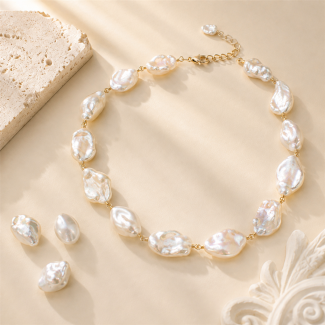
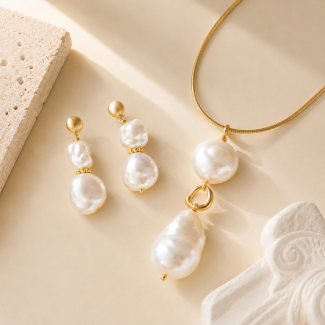
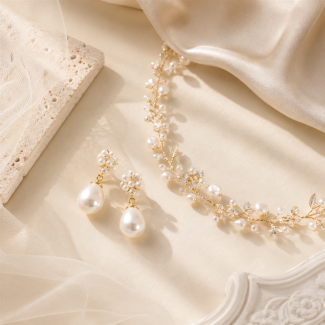
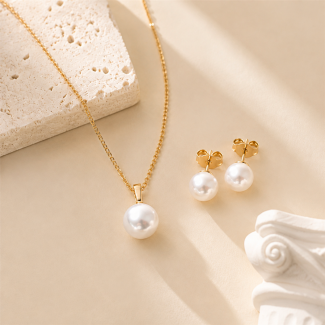
Yes. Cultured freshwater pearls are real pearls. They grow inside freshwater mussels after a pearl farmer initiates the process. They are not the same as imitation pearls made from glass, plastic, coated shell or other manufactured materials.
The source of confusion is the word “cultured.” In pearl terminology, cultured describes human involvement in starting the pearl’s growth; it does not mean synthetic or fake.
What does “real pearl” mean?
In everyday language, “real pearl” usually includes both natural and cultured pearls because both are formed by mollusks. Gem and jewelry descriptions should still identify which type is being sold.
- Natural pearl: forms in a mollusk without deliberate human intervention.
- Cultured pearl: forms in a mollusk after people deliberately initiate the growth process.
- Imitation pearl: is manufactured to look like a pearl but does not grow inside a mollusk.
Natural pearls are rare in modern jewelry. Most real pearl jewelry on the market uses cultured pearls.
How cultured freshwater pearls form
Freshwater cultured pearls grow in mussels living in lakes, rivers or ponds. In a common tissue-nucleation method, a technician inserts a small piece of mantle tissue into the mussel. A pearl sac forms, and the mussel deposits layers of nacre as the pearl develops.
Some modern freshwater cultured pearls are bead-nucleated. In this method, a shell bead and mantle tissue help begin the process. Both tissue-nucleated and bead-nucleated freshwater pearls are cultured pearls.
For a fuller explanation of origin, appearance, colours and quality, learn more about freshwater pearls.
Cultured does not mean imitation
A cultured pearl is produced through a biological process inside a living mollusk. An imitation pearl is manufactured outside a mollusk and is designed to simulate the appearance of pearl material.
Common imitation materials include coated glass, plastic and shell beads. Imitations can be attractive and useful in fashion jewelry, but they should be described honestly so a buyer understands the material and price.
Under FTC guidance for U.S. jewelry advertising, sellers should identify pearls as cultured or imitation. For cultured products, a clear description such as “cultured freshwater pearls” is more precise than using “pearl” alone.
Is “freshwater pearl” enough information?
“Freshwater” tells you the growing environment, not whether the pearl is natural, cultured or imitation. Because most freshwater pearls in contemporary jewelry are cultured, many shoppers use “freshwater pearl” as shorthand. A complete product description should say “cultured freshwater pearl.”
It should also disclose treatments when they are not permanent, require special care or significantly affect value. Dyeing, bleaching, coating and irradiation can change appearance.
Why are real freshwater pearls often affordable?
Price is not a simple real-versus-fake test. Freshwater mussels can produce multiple cultured pearls in a cultivation cycle, and production is substantial. That supply helps make genuine cultured freshwater pearls accessible.
Quality still varies. Fine freshwater pearls can have bright lustre, appealing colour, strong nacre quality and round or beautifully irregular shapes. A low price may reflect size, shape, production volume or simple construction rather than imitation material.
Does an irregular shape prove a pearl is real?
No. Natural variation is common in cultured freshwater pearls, but imitation pearls can also be manufactured with irregular surfaces and shapes. Conversely, cultured pearls can be very round and closely matched.
Shape is one clue within a larger picture, not proof. Look for clear material disclosure and consider surface, drill holes, lustre and construction together. Our guide to checking whether pearls are real explains the limits of common home tests.
What should a trustworthy product description say?
Look for specific, plain-language information:
- “Cultured freshwater pearl” rather than an unexplained “pearl-like” material
- Pearl size in millimetres
- Shape, such as round, oval, drop or baroque
- Any relevant colour treatment or coating
- Metal and construction details
- Photographs that show natural surface and shape honestly
If the wording is vague, ask whether the pearls are cultured or imitation. A responsible seller should be able to answer directly.
Can you tell natural and cultured pearls apart at home?
Not with certainty. Natural and cultured pearls are both formed by mollusks and can look similar from the outside. Laboratories use methods such as X-radiography to examine internal growth structures.
For ordinary jewelry, clear seller disclosure may be enough. For an heirloom, unusually valuable strand or insurance decision, professional gemological identification is more appropriate than a home test.
Continue learning about pearl types and terminology in our guide to understanding pearls.
Frequently asked questions
Are cultured freshwater pearls fake?
No. They are real pearls grown in mussels with human assistance at the beginning of the process.
Are all freshwater pearls cultured?
Natural freshwater pearls exist, but they are rare. Most freshwater pearls sold in modern jewelry are cultured.
Why do some real freshwater pearls have marks?
Small ridges, dimples and surface variations can develop during growth. They should be distinguished from cracks, peeling, abrasion or damaged drill holes.
Can imitation pearls look convincing?
Yes. Some imitations reproduce colour, weight and surface texture well enough that one visual clue is unreliable. Accurate disclosure and professional testing matter when certainty is important.